
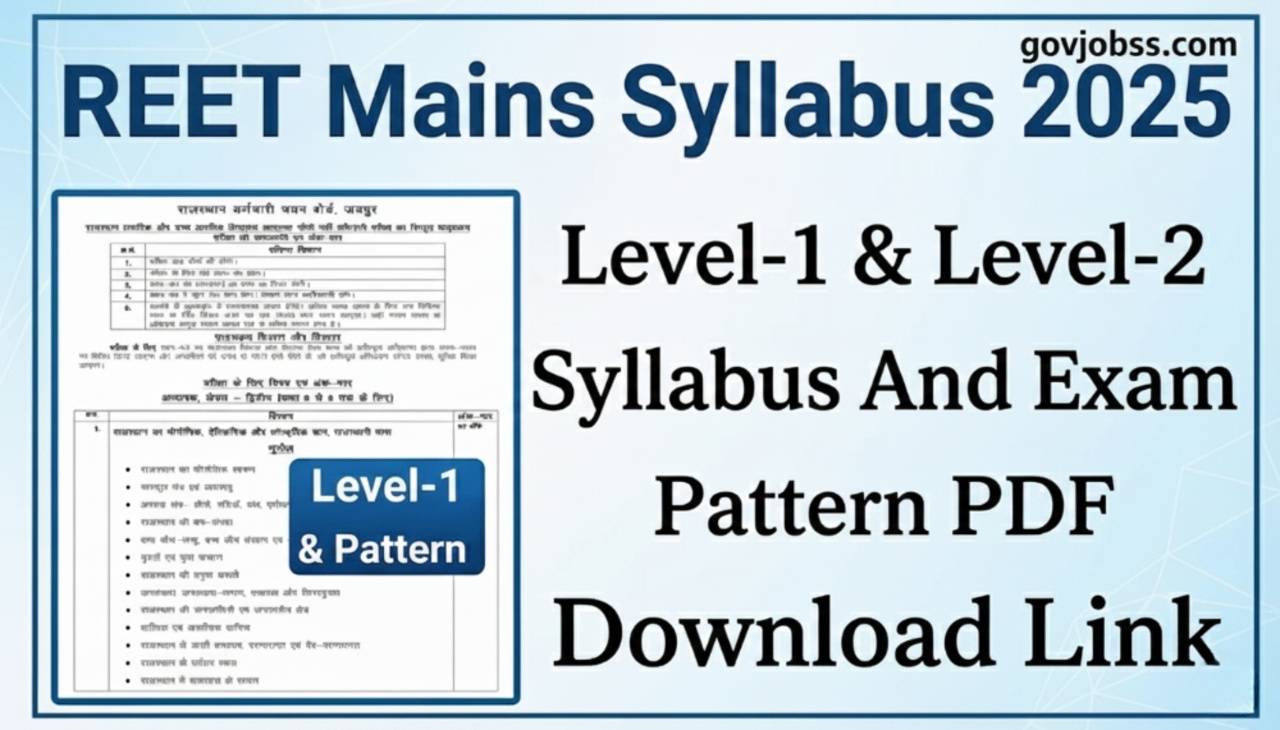
When you first open the syllabus it feels like a long list of topics. That’s normal. Once you sit with it for a bit you start seeing patterns: a big chunk is about the state (Rajasthan), another chunk tests basic teaching sense, and then each subject follows the school curriculum. I rewrote everything here in plain words and recreated the tables so you can copy this straight into a WordPress post.
Quick glance at the exam idea
The exam splits into parts that check your knowledge of Rajasthan, general awareness and reasoning, educational psychology, basic IT, and the subject you choose to teach. Level 1 is for primary (classes 1–5) and Level 2 is for upper-primary (classes 6–8). The structure is familiar if you’ve seen previous REET papers — but pay attention to how much Rajasthan content appears. It matters.
Tip: keep a dedicated notebook for state facts and one for teaching-method ideas. Both pay off more than you might expect.
Level 1 (Classes 1 – 5) — Overview
Level 1 focuses on early-grade classroom needs. The table below groups the syllabus areas and describes what each includes in plain phrases.
| Section | What to expect / key topics |
|---|---|
| Rajasthan: Geography | Major physical features, Aravalli basics, the Thar region, rivers, soil types, rainfall patterns, water issues |
| Rajasthan: Culture & Society | Folk music and dance, well-known festivals, local crafts and artisans, traditional attire, common dialectal features |
| Rajasthan: History | Important kingdoms and rulers, freedom movement episodes connected to the state, famous historical sites and personalities |
| Elementary school curriculum | Early maths ideas (numbers, basic operations, shapes), EVS topics (plants, animals, environment, family), simple language skills |
| General Knowledge & Current Affairs | Basic national facts, recent state and national events, government schemes that affect schools, notable appointments and awards |
| Reasoning | Number patterns, simple series, coding-decoding, directions, basic logical puzzles |
| Educational Psychology | Child growth stages for early years, how young children learn, classroom interaction techniques, basics of assessment for primary grades |
| Information Technology | Computer parts and uses, basic software (word processing), email and internet basics, online safety for children |
| Teaching Subjects (Level 1) | Hindi, English, Maths, EVS, and regional language options — questions align with classes 1–5 curriculum |
Level 1 — Subject-wise hints
For primary maths, focus on number sense, simple fractions, measurements and word problems. For languages, basic grammar, comprehension and simple composition. EVS is mostly observation-based — plants, food, family, health and environment.
Level 2 (Classes 6 – 8) — Overview
Level 2 expects a deeper grip on subjects and on how adolescents learn. The state-related content is still strong, but the teaching-subject questions align with middle-school textbooks.
| Section | What to expect / key topics |
|---|---|
| Rajasthan: Physical & Human Geography | Aravalli range details, desert ecology, irrigation and rivers, distribution of crops, resources and conservation issues |
| Rajasthan: History & Heritage | Major dynasties, important battles and treaties, architectural monuments, social reforms and reformers |
| Rajasthan: Culture | Literary traditions, performing arts, craft clusters, major festivals and fairs |
| Middle-school curriculum | Science (basic physics, chemistry, biology), maths (algebra starts), social studies topics at class 6–8 level |
| General Knowledge & Current Affairs | Wider national issues, state initiatives, important scientific and policy updates, major awards |
| Reasoning & Data Interpretation | Logical sequences, basic data reading, simple interpretation of charts and tables |
| Educational Psychology (older children) | Adolescent cognitive development, peer influence, motivation techniques, assessment strategies and remediation |
| Information Technology | Online teaching tools, e-content basics, cyber safety and classroom apps |
| Teaching Subjects (Level 2) | Hindi, English, Maths, Science, Social Studies, and regional languages — aligned to classes 6–8 syllabus |
Level 2 — Subject pointers
Maths will push into algebra, ratios, geometry proofs at a conceptual level. Science questions usually check understanding of basic principles (like forces, structure of matter, ecosystems). Social studies mixes history facts with geography and civics basics. NCERT-style study is useful here; questions often mirror school textbook emphasis.
Educational Psychology — what really matters
People skim this section and then wonder why they lose marks. The good news is that many topics here are straightforward if you think like a teacher: how children at a certain age typically learn, common difficulties and simple classroom responses, ways to check understanding without heavy tests. Focus on:
- Stages of cognitive and social development for the relevant age group
- Simple assessment methods and how to interpret results
- Methods to include children with different needs and abilities
- Activity-based classroom techniques and examples
Information Technology — the short but useful part
IT is small in weight, but the points are practical. Know the difference between hardware and software, common classroom apps, how to use a word processor to prepare simple worksheets, and basic internet safety rules you’d explain to children.
How the teaching-subject papers are framed
Each subject paper tests both subject knowledge and the ability to teach that topic. Expect questions that ask for correct factual answers, and some that check-for-teaching-sense — like how to explain a tricky concept to a child, or which activity would best develop understanding of a topic.
| Subject | Focus (classes 1–5) | Focus (classes 6–8) |
|---|---|---|
| Hindi | Basic grammar, short prose and poems, comprehension | Advanced grammar topics, literature pieces from school texts, longer comprehension |
| English | Vocabulary, sentence formation, elementary reading | Grammar in context, reading passages, writing skills |
| Mathematics | Number sense, shapes, measurements, simple word problems | Algebra basics, geometry, ratios, percentage, mensuration |
| Science | Basic life-science and environment, simple physical phenomena | Foundations of physics, chemistry and biology from middle-school texts |
| Social Studies | Local history and civics basics, map-reading | History narratives, geography concepts, civics structure |
Revision strategy that actually helps
One thing that works: split study time between state-specific facts and teaching-method ideas. Cover subject topics from NCERT or state textbooks and then spend a steady 15–20% of study time on child development and classroom techniques. For current affairs, a rolling 2–3 week revision of major events is usually enough for this level of exam.
Practical study plan idea: spend alternate days on subject content and on state facts. Use weekends for mock tests and quick psychology revision.
Final notes (short)
There’s no magic trick here — steady, focused study and a habit of thinking like a classroom teacher go a long way. The Rajasthan part is heavy, but it’s factual and repeatable. Educational psychology rewards common sense and simple examples. Subject papers reward clarity, so phrase answers like you’d explain a point to a student.
If you want, I can convert this to a downloadable PDF, or give you a WordPress-ready HTML with tables kept as images for a specific theme. Tell me which format you prefer and I’ll prepare it.


Leave a Comment