
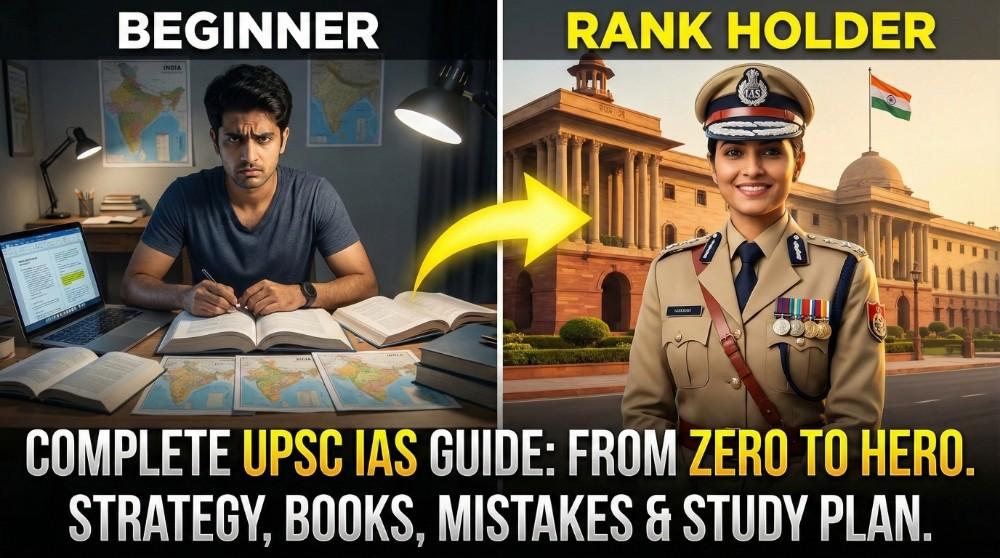
So you’ve decided to prepare for the UPSC IAS exam. That’s huge. But now you’re probably sitting there thinking, “Okay, where do I even start?” The good news? You’re not the first person to feel this way, and with the right plan, you won’t be the first to crack it either.
The UPSC Civil Services Exam is India’s toughest competitive exam, but “tough” doesn’t mean “impossible.” Thousands of candidates clear it every year, and many of them started exactly where you are right now—confused, motivated, but unsure about the next step. This guide will walk you through the entire process, from understanding what the exam actually is to building your daily study routine and avoiding the mistakes that cost most aspirants months of wasted effort.
What Is the UPSC IAS Exam?
Let’s start with the basics. UPSC stands for Union Public Service Commission, and IAS is the Indian Administrative Service. When people talk about “cracking UPSC,” they usually mean the Civil Services Examination (CSE), which selects candidates for IAS, IPS (Indian Police Service), IFS (Indian Foreign Service), and other Central Government posts.
The exam has three stages: Prelims, Mains, and Interview. Think of it like a funnel—each stage narrows down the competition. About 10 lakh (1 million) people take Prelims, but only 15,000-20,000 make it to Mains, and finally, only around 1,000 get selected.
You get six attempts (or until age 32, whichever comes first) if you’re a general category candidate, so you’ve got time to get it right. Don’t panic if you don’t clear it on the first try—most successful candidates don’t.
Understanding the Exam Pattern and Syllabus
Prelims: This is a qualifying stage with two papers, each lasting 2 hours. Paper I (General Studies) has 100 questions, and Paper II (CSAT—Civil Services Aptitude Test) has 80 questions. Both are multiple choice. Prelims is designed to filter out candidates who lack basic knowledge, but the real test happens in Mains.
Mains: If you clear Prelims, you move to Mains, which is where your actual knowledge matters. You’ll write 9 papers across different subjects. You’ll have two language papers (qualifying only), four General Studies papers, one essay paper, and two optional subject papers. Each answer needs to be around 1,000-2,000 words, written within 3 hours. This is where most candidates struggle because it’s not about memorizing—it’s about thinking clearly and writing well.
Interview: After Mains, if you rank well enough, you’ll face the Personality Test (interview). This is 20% of your final score, so don’t take it lightly.
The key thing to understand? The syllabus is huge. You’re expected to know about Indian history, polity, geography, economics, science, environment, current affairs, and more. That’s why a proper strategy matters more than raw intelligence.
How to Start Your UPSC Preparation: The Right Way
Step 1: Get Your Basics Right with NCERT Books
Before you buy fancy reference books, start with NCERT textbooks from Class 6-12. These are the foundation. Seriously, don’t skip this. Many candidates ignore NCERTs thinking they’re “too basic,” then wonder why they can’t answer questions clearly.
Read NCERT books for History, Geography, Science, Civics (Polity), and Economics. You don’t need to memorize every word, but you should understand the concepts. Aim to finish all NCERTs in your first 3 months. This gives you a solid foundation and saves you from getting lost in complicated reference books later.
Step 2: Analyze Previous Year Papers
This is crucial and many beginners skip it. Go through past 10 years of UPSC Prelims and Mains papers. Don’t just look at them—actually solve them. This shows you what UPSC actually tests, not what coaching centers think they test.
You’ll notice patterns. Certain topics come up repeatedly. Certain question types dominate. This insight will shape how you study. If you’re wondering where to find these papers, they’re freely available on the UPSC website and various prep portals.
Step 3: Choose Your Optional Subject Carefully
For Mains, you’ll choose an optional subject (like History, Geography, Sociology, etc.). This is a big decision because you’ll spend 3-4 months preparing for it. Choose something you’re interested in or have studied before. Don’t pick the “easiest” optional thinking you’ll score high—if you’re not interested, you’ll burn out.
Building Your Daily Study Routine
This is where most people fail. They study for a month with fire in their belly, then fizzle out because they don’t have a sustainable routine.
For Full-Time Aspirants:
You need 6-8 hours of focused study daily. Here’s a sample day:
- 6-7 AM: Read the newspaper (The Hindu, Indian Express, or PIB summaries) for current affairs
- 7-8 AM: Make notes on what you read
- 8-9 AM: Breakfast and a short break
- 9 AM-1 PM: Deep study session—tackle one subject thoroughly (history, geography, polity, economy—rotate these)
- 1-2 PM: Lunch
- 2-4 PM: Answer writing practice or test series (3-4 times a week)
- 4-5 PM: Revision of previous notes
- 5-7 PM: Current affairs reading or optional subject study
- 7 PM onward: Light study or break
The key? Don’t study for 12 hours and burn out. Consistent 6-8 hours daily beats chaotic 12-hour sessions.
For Working Professionals:
You can’t match full-time aspirants hour-for-hour, so be smart:
- Study 2-3 hours daily on weekdays (early morning or late evening)
- Use weekends for intensive study sessions (4-6 hours)
- Prioritize. Focus on important topics first
- Don’t take too many test series—quality over quantity
- Expect it to take 18-24 months instead of 12 months
The advantage? Your work experience and maturity help in Mains and interviews.
The Three Pillars of UPSC Success
Pillar 1: Reading (Static Knowledge)
You need to read broadly. NCERT books aren’t enough for Mains. Read standard reference books like:
- Laxmikanth for Polity
- Ramesh Singh for Economics
- Majid Husain for Geography
- ICSE History books for clarity
Don’t try to read everything at once. Focus on one subject at a time.
Pillar 2: Current Affairs
Many candidates prepare only static knowledge and ignore current affairs. Big mistake. About 30-40% of Mains questions need current affairs knowledge. Read newspapers daily. Follow news portals. Make notes. This should be a daily habit, not something you cram before the exam.
Pillar 3: Practice (Answer Writing & Test Series)
Reading alone won’t get you through Mains. You need to practice writing answers within time limits. This seems simple, but it’s where most candidates stumble. Many know the answer but can’t write it clearly in 7 minutes.
Join a test series (online or offline) that covers the entire syllabus systematically. Take tests regularly, analyze your performance, and improve. This isn’t optional—it’s mandatory.
Common Mistakes to Avoid
Mistake 1: Over-reading
Candidates often read 20+ reference books thinking more reading = higher marks. Wrong. Deep reading of 5-6 quality books beats shallow reading of 20 books. Focus on mastering the core concepts.
Mistake 2: Ignoring Revision
You’ll study a lot, but you’ll forget even more if you don’t revise. Build regular revision into your schedule. Every topic should be revised at least 3-4 times before the exam.
Mistake 3: Skipping Prelims Strategy
Many candidates rush through Prelims thinking Mains is the real deal. Wrong again. If you don’t crack Prelims, you never get to Mains. During Prelims season (January-June), spend 70% of your time on Prelims topics and previous year questions.
Mistake 4: Not Taking Mains Preparation Seriously Until After Prelims
Smart candidates integrate Prelims and Mains preparation. When you study a topic for Prelims (like history), also think about how it could be a Mains question. This integrated approach saves time.
Mistake 5: Comparing Your Journey to Others
Every candidate’s journey is different. Some clear it in 12 months, others take 3 years. Some rank in top 100, others rank in 1000s. Don’t compare. Focus on your own progress.
Your 12-Month Study Plan (Overview)
Months 1-3: Foundation
- Complete NCERT books
- Analyze previous year papers
- Build basic notes
Months 4-6: Deep Dive
- Expand on NCERTs with reference books
- Start Prelims test series
- Daily current affairs reading
Months 7-8: Prelims Focus
- Take full-length Prelims tests weekly
- Revise all topics
- Work on speed and accuracy
After Prelims (Months 9-12): Mains Push
- Answer writing practice
- Mains test series
- Optional subject deep study
- Interview preparation (if you clear)
Final Thoughts
UPSC IAS preparation isn’t a sprint—it’s a marathon. There’s no magic formula, no shortcut. What works is consistency, the right strategy, and the willingness to put in the work over months.
You’ll have days when you feel on top of the world, and days when you’ll question everything. Both are normal. The candidates who clear this exam aren’t necessarily the smartest—they’re the most consistent.
Start today. Start small if you need to, but start. Read one NCERT chapter. Solve one previous year question. Build from there. Every successful IAS officer once sat where you’re sitting now, confused and wondering if they could do it.
They did. So can you.


Leave a Comment